If you or your team ever pay for business expenses out of pocket, an accountable plan may help you handle reimbursements the right way.
If you or someone on your team pays for business expenses personally and then gets reimbursed, there’s a right way to handle that reimbursement... and then there’s the “oops, we accidentally turned that into taxable wages” way.
That’s where an accountable plan comes in.
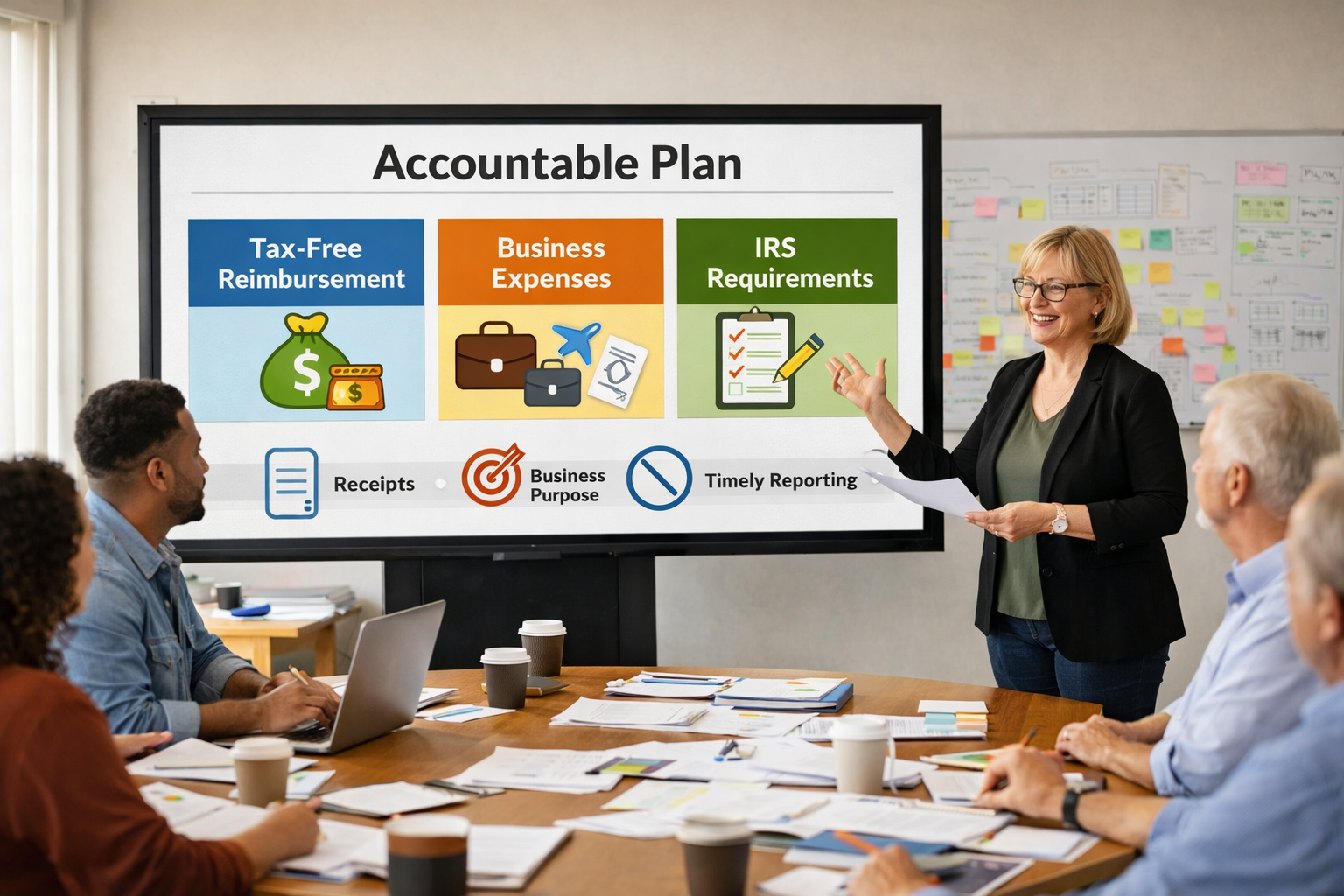
An accountable plan is an IRS-approved reimbursement arrangement that allows a business to repay employees for legitimate business expenses without treating those reimbursements as taxable income, as long as certain rules are followed. That means the employee can be reimbursed tax-free, and the business may also avoid paying payroll taxes on those amounts.
For small business owners, that can be a big deal.
So what does that actually mean?
Let’s say an employee pays for mileage, travel, meals during business travel, or another qualifying business expense out of pocket. If your business reimburses that expense through a properly structured accountable plan, that reimbursement is generally not added to wages.
That means it typically does not get hit with federal income tax withholding, Social Security, Medicare, or unemployment taxes the way regular payroll would.
That’s the part business owners like.
The IRS likes the documentation part.
What does the IRS require?
To qualify as an accountable plan, the IRS says three things must happen:
-
First, the expense must have a business connection.
The expense needs to be directly related to the business. This is not for personal purchases pretending to be “sort of work-ish.”
-
Second, the expense must be substantiated.
That means the employee needs to provide documentation such as receipts, mileage logs, dates, amounts, and the business purpose of the expense.
-
Third, any excess reimbursement must be returned.
If the business reimburses more than the actual expense, the extra amount needs to be paid back within a reasonable period.
If those rules are not followed, the reimbursement can lose its special treatment and become taxable wages instead.
Why accountable plans can be so helpful for small businesses
A lot of small business owners are used to paying for things on the fly. Maybe a team member grabs supplies. Maybe someone travels for a meeting. Maybe an owner-employee covers a business expense personally and wants to be reimbursed later.
Without a clear reimbursement process, those payments can get messy fast.
A good accountable plan helps by creating structure.
It can help you:
-
Avoid unnecessary payroll taxes
When reimbursements are handled properly, they generally are not treated as wages.
-
Keep reimbursements tax-free for employees
The employee gets repaid for a legitimate business expense without that reimbursement increasing taxable income.
-
Improve documentation
Instead of random transactions and mystery charges showing up later, you have receipts, dates, and business purpose tied to the reimbursement.
-
Keep cleaner books
Cleaner reimbursement records mean fewer questions at month-end, fewer surprises at tax time, and a better paper trail if anyone ever needs to review the records.
In other words, it’s not just a tax topic. It’s also a bookkeeping and process topic. And around here, we like clean process. It saves headaches.
What kinds of expenses might be reimbursed?
This depends on the facts and how the reimbursement is set up, but common examples may include:
- Business mileage
- Travel expenses
- Lodging
- Meals connected to business travel
- Other ordinary and necessary business expenses paid personally by an employee
The key is that the expense must be legitimate, business-related, and properly documented.
What an accountable plan is not
This is where people can get themselves into trouble.
An accountable plan is not:
- A flat monthly allowance with no receipts
- A random payment labeled “reimbursement” just because it sounds better than “payroll”
- A workaround to avoid taxes on compensation
- A loose system with no deadlines or documentation
If reimbursements are not tied to actual business expenses, or if there is no substantiation, the IRS can treat those amounts as wages.
So yes, calling something a reimbursement does not magically make it one. The IRS is annoyingly serious about that.
Practical tips for setting one up
If your business wants to use an accountable plan, a little structure goes a long way.
-
Start with a written policy, even if it’s simple. Spell out what kinds of expenses are eligible, what documentation is required, when employees need to submit expenses, and how overpayments are handled.
-
Make sure reimbursements are tied to real expenses and supported by real records.
-
Make sure someone is actually reviewing that documentation before payments go out.
This doesn’t have to be complicated, but it does need to be intentional.
Final thought
An accountable plan can be a smart tool for small business owners who want to reimburse business expenses the right way. When handled properly, it can reduce payroll tax exposure, keep reimbursements tax-free, and create cleaner, more reliable records. That’s a pretty solid win across the board.
If your business is reimbursing expenses without much structure, this may be a good time to review your process and make sure it’s working the way you think it is.